Voltmasters Platform
Load management
Load management in the Voltmasters EMS: limits per energy meter on top of the grid connection limits, with per-phase protection and the order in which the EMS intervenes.
Load management keeps the power flowing through an energy meter below limits you set. It is configured per meter, on the meter’s Load Manager tab.
The limits of the grid connection itself are set in the project settings, with the access power and the peak shaving reserve. Load management adds limits on meters deeper in the installation.
| Setting | Description |
|---|---|
| Enable Load Management | Switches load management on for this meter. |
| Maximum injection power (kW) | The highest power the installation behind this meter may feed back. |
| Maximum consumption power (kW) | The highest power the installation behind this meter may draw. |
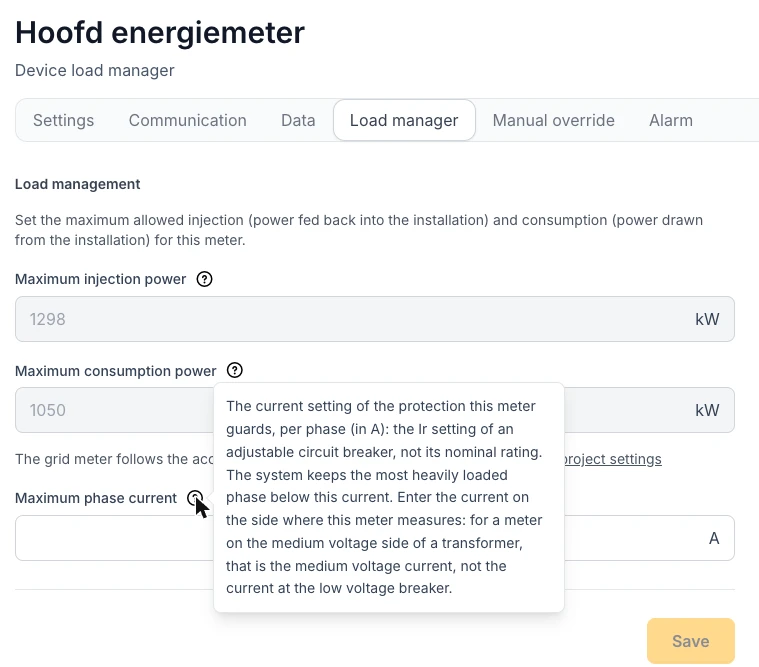
| Maximum phase current (A) | The highest current per phase through this meter. See Maximum phase current. |
Limits across the whole metering hierarchy
Every meter can carry its own limits, and the EMS enforces them all at the same time, together with the limits of the grid connection. A sub-meter protects what sits behind it, such as a transformer, a distribution board, a cable or a single building, even when the grid connection still has room. A busy sub-circuit is throttled without slowing down the rest of the site.
flowchart TD
    N["Grid"] --- H["Main meter: grid connection limits"]
    H --- A["Sub-meter building A: own limit"]
    H --- B["Sub-meter charging area: own limit"]
    A --- V["Loads in building A"]
    B --- E["EV chargers"]
Unevenly loaded phases: per-phase protection
The limits are set in kW for the connection as a whole, but on a three-phase connection the fuses and the connection rating are per phase. When the phases are loaded unevenly, the total can be well below the limit while one phase is already over its share, and it is that single phase that trips the main breaker.
When the meter measures its power per phase, the EMS therefore protects each phase as well. It does so pessimistically: every limit check treats the site as if all three phases carried the same load as the heaviest one.
%%{init: {"xyChart": {"height": 300}, "themeVariables": {"xyChart": {"plotColorPalette": "#f8b81e, #0a0a0a"}}}}%%
xychart-beta
    x-axis ["L1", "L2", "L3"]
    y-axis "kW per phase" 0 --> 10
    bar [4.5, 8.5, 4.5]
    line [7.33, 7.33, 7.33]
In this example L1 and L3 each draw 4.5 kW and L2 draws 8.5 kW. The total of 17.5 kW stays under the 22 kW limit, but L2 is over its 7.3 kW share. The EMS therefore counts 3 × 8.5 = 25.5 kW, more than 22 kW, and reduces the load until L2 fits.
Maximum phase current
Next to the kW limits, every physical energy meter has a Maximum phase current in A, also the grid meter. On the grid meter the kW limits follow the access power from the project settings, but you set the maximum phase current here. The EMS keeps the most heavily loaded phase below this current.
- Enter the current setting of the protection this meter guards, per phase: the Ir setting of an adjustable circuit breaker, not its nominal rating.
- Enter the current on the side where the meter measures. For a meter on the medium voltage side of a transformer, that is the medium voltage current, not the current at the low voltage breaker.
- The limit only works on a meter that reports the current per phase. If it does not, the tab says so and the limit is not watched.
- The maximum phase current needs controller version 0.0.339 or later.
Three incidents report problems with it:
- Phase current above the maximum set for the meter.
- Phase current limit cannot be met by symmetric steering: the EMS steers the three phases evenly and cannot bring the heaviest phase below the maximum that way.
- Maximum phase current set on a meter that does not measure phase currents.
See Incident management.
What the EMS does when a limit is approached
When the power measured by a meter approaches its limit, the EMS intervenes, from the least disruptive measure to the most. By default that is:
- The battery: charging is reduced or stopped and, if needed, the battery discharges to take load off the meter.
- EV charging: the charging power of the EV chargers behind that meter is curtailed.
- Controllable loads: on/off loads are switched off.
Only when a step cannot free up enough power does the EMS move to the next one, so equipment is switched off as a last resort.
On the grid the battery is always limited first. The order of the loads after it is set for the whole project under Load shedding priorities. Devices under Critical: do not shed are never shed.