Voltmasters Platform
Incident management
Track incidents on a Voltmasters EMS project: the incident list with its tabs and filters, and what each entry says about device and type.
Incident overview
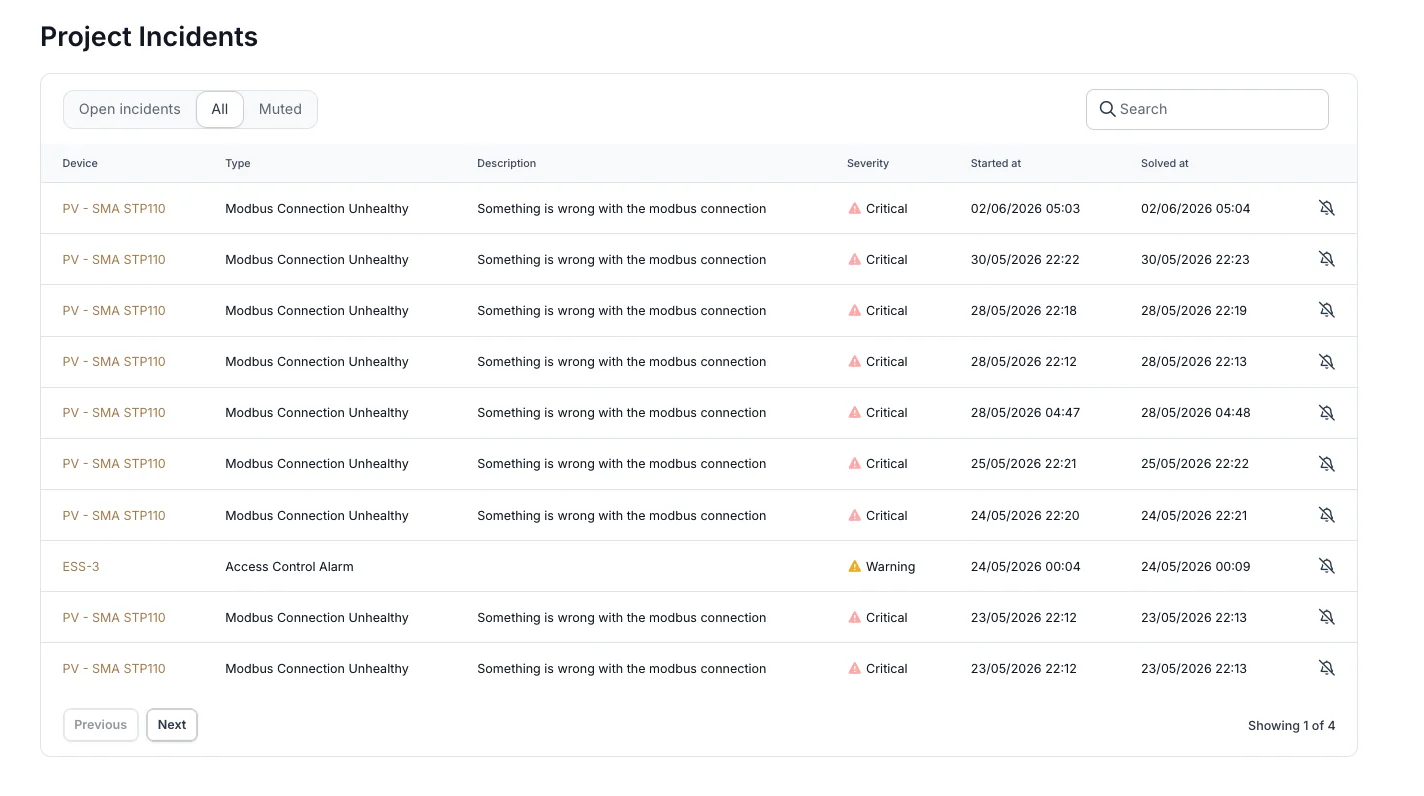
The Incidents page lists all active and historical incidents for the project. Each entry shows the project, device, incident type and a description. Use the filters to focus on unresolved issues or to search the incident history.
Project-specific incidents can also be accessed via the Incidents tab within a project.
The tabs
The incident list is split into three tabs:
| Tab | What it shows |
|---|---|
| Open incidents | Everything currently unresolved. This is the working view. |
| All | Open and closed incidents, muted ones excluded. |
| Muted | Only the incidents of a muted type, so a silenced type stays inspectable. |
Muting an incident type
Some alarms are correct but not useful on a given installation: a device that is knowingly offline, a limitation that is expected on this site, a warning about hardware that is being replaced next week. Rather than living with a permanently red list, you can mute the incident type.
Muting works per type, not per incident. From an incident in the list, use the mute action and choose the scope:
| Scope | Effect |
|---|---|
| Mute for device | Only this device stops raising this incident type. Other devices keep raising it. |
| Mute for project | No device in the project raises this incident type any more. |
Device scope is the one to reach for by default; project scope is for a type that is genuinely irrelevant to the whole installation.
What muting does and does not do:
- Incidents of a muted type are still recorded. They move to the Muted tab instead of the open list, so nothing is lost and you can always see what has been happening.
- Muted incidents no longer send email or push notifications.
- Muting is reversible at the same scope it was applied: unmute for the device, or unmute for the project.
- The Muted by column shows who muted the type, so a silenced alarm can always be traced back to the person who silenced it and the decision can be revisited.
A type can also be muted for a deleted device, which matters when a removed device keeps producing noise on its way out.
Muting hides a symptom, it does not fix a cause. Use it for a known and accepted situation, and prefer the device scope so the same alarm elsewhere in the installation still reaches you. Review the Muted tab every so often: a mute that was meant to last a week has a way of lasting a year.
Severity
Each incident has a severity: Info, Warning or Critical. Notifications are deliberately limited: both email and mobile push notifications are only sent for Critical incidents, so the channels stay meaningful and do not fill up with informational noise. Incidents of every severity remain visible in the incident list. Some controller- and grid-level incidents are treated as emergency notifications and are surfaced immediately.
Frequently asked questions
Which incidents trigger a notification?
Almost all incidents appear in your incident list, including faults, warnings and informational alerts for devices, the EMS controller and grid limits.
Email notifications are bundled and delivered for Critical incidents only:
- A first email is sent once the incident has been open for at least five minutes (not yet resolved and not previously included in a bundle).
- A follow-up email may be sent approximately twelve hours after the incident began, if it is still open at that time.
Mobile push notifications are likewise limited to Critical incidents. A push notification is withdrawn automatically once the incident it announced is resolved.
Incidents of severity Info and Warning are recorded and shown in the incident list, but do not generate an email or a push notification.
How long before a notification is sent?
| Notification channel | Timing |
|---|---|
| Email (Critical incidents) | After the incident has been open for at least 5 minutes |
| Email follow-up | Approximately 12 hours after the start of the incident, if still unresolved |
| Mobile push (Critical only) | Sent when the incident is raised, and withdrawn when it is resolved |
How do I configure notification recipients?
Under Settings → Incident rules, you can control which users receive notifications for this project.
- Navigate to Settings → Incident rules.
- You will see a list of users associated with the project.
- Toggle the switch next to a user's name to on to enable email and portal notifications for that user.
- Toggle it off to stop sending notifications to that user.
This configuration is per project; changes here only affect notifications for the current project.
Voltmasters EMS: incident management