DSO RTU
Fall-Back Flex
Fluvius Fall-Back Flex with the Voltmasters EMS: what the formula asks of a site, how the controller keeps net consumption below the Fluvius limit, and what an installation needs.
Fall-Back Flex is a temporary connection formula from Fluvius for new or reinforced connections in congested zones. The site gets its full requested capacity, but has to bring its net consumption below a limit whenever Fluvius signals congestion. The Voltmasters controller does that automatically, with the battery, the EV chargers and the controllable loads.
Fall-Back Flex runs on top of the Fluvius Netflex RTU: Fluvius sends the limit over the same link it uses for its other setpoints.
Key terms
| Term | Meaning |
|---|---|
| P_base | The contractual consumption power of the connection, from the bid form. Every Fluvius percentage refers to it. |
| P_red | The reduced power from the awarded bid: the lowest limit Fluvius can order. |
| Flexible volume | P_base minus P_red: the power the site must be able to give up. |
| Limit | The setpoint Fluvius sends (MAXSETP), a percentage of P_base. 70 % on a P_base of 500 kW means at most 350 kW net consumption. 100 % means no limit. |
| Response time | 3 minutes. Within that time the net consumption has to be at or below the limit. |
How it works
Fluvius sends a limit
The Netflex RTU passes the limit to the controller, which converts the percentage into kW with P_base. From that moment the site has 3 minutes.
The controller holds devices back, in a fixed order
First the battery (it stops charging, then discharges), then the EV chargers (lower power or paused), then the controllable loads (switched off). After every step it checks the grid meter and only goes further when needed.
The site stays below the limit
The controller keeps following the grid measurement. If consumption rises during the activation, it holds back more. If it drops, it gives power back.
Fluvius lifts the limit
Consumption comes back gradually, at most 10 % of P_base per minute, in reverse order: loads first, battery last.
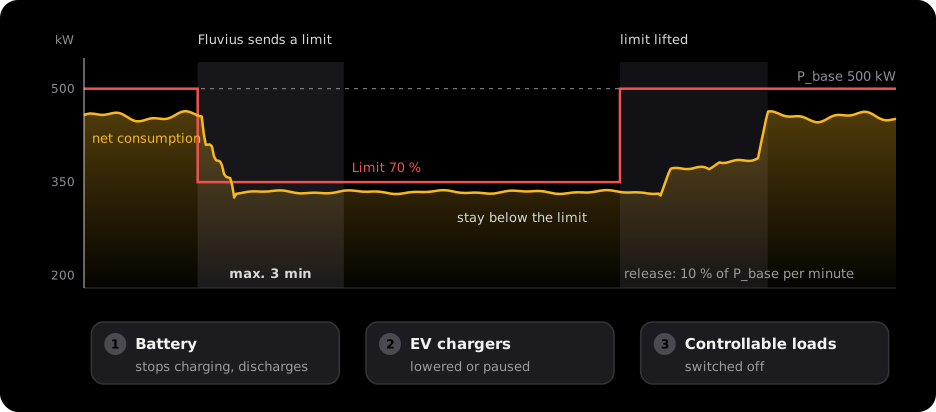
An activation from start to finish (schematic time axis).
In zones with day-ahead steering, Fluvius also publishes the limits one day ahead. The controller then charges the battery before a planned limit and uses it during the limit. See Day-ahead planning.
What the site needs
| Component | Role |
|---|---|
| Fluvius Netflex RTU | Delivers the limit from Fluvius to the controller. |
| Voltmasters controller | Converts the limit into kW and holds devices back. Needs a software version with Fall-Back Flex support. |
| Grid meter at the connection point | Measures the net consumption the controller steers on. |
| Flexible devices | Battery, EV chargers and controllable loads (through an IO module). Together they must cover the flexible volume. |
| OV client certificate (only with day-ahead steering) | Gives the controller access to the Fluvius planning API. See Planning certificate. |
Good to know
- Fall-Back Flex only limits consumption. It never limits injection and never drives net consumption below 0 kW.
- The controller removes only what is needed. Devices that are not needed keep running.
- A test from Fluvius (reason code 99) is followed exactly like a real activation.
- The controller runs locally: an activation is executed without internet as well.
How this section is organized
How an activation worksThe order of the devices, the safety margin, the release and what happens when something fails. Day-ahead planningThe plan from the Fluvius planning API and the battery preparation. ConfigurationThe settings, step by step. MonitoringThe Fall-Back Flex page and the dashboard tile. Incidents and notificationsWhat the platform reports and what to do. Planning certificateOrdering, registering and renewing the certificate for day-ahead steering.Frequently asked questions
Is Fall-Back Flex the same as DSO RTU (telecontrol)?
No. DSO RTU is the control link with the grid operator. Fall-Back Flex is a connection formula that uses that link. A project can have the Netflex RTU without Fall-Back Flex, not the other way around.
How does Fluvius judge whether the site complied?
Per quarter hour, on the billing meter at the connection point. A quarter hour at or below the limit counts as delivered. The activation history shows the same quarter-hour view.
What if the flexible devices cannot cover the flexible volume?
Then an activation cannot always be honoured and the platform raises Fall-Back Flex has no flexibility left while consumption still exceeds the limit. Add flexible consumption, for example loads switched through an IO module.
How long does Fall-Back Flex apply?
Until Fluvius has reinforced the grid in the zone, or until the formula is converted into a flexible connection agreement. The Netflex RTU stays in use afterwards.