Voltmasters Platform
Battery (advanced)
The advanced Battery dashboard shows everything the controller records about each battery unit: power against setpoint and limits, state of charge, run state, grid mode, temperatures and the raw registers.
The Battery dashboard under Advanced shows everything the controller records about each battery unit, so a trip, an oscillation or a limit can be read over time. It appears on projects with a battery inverter or a BMS.
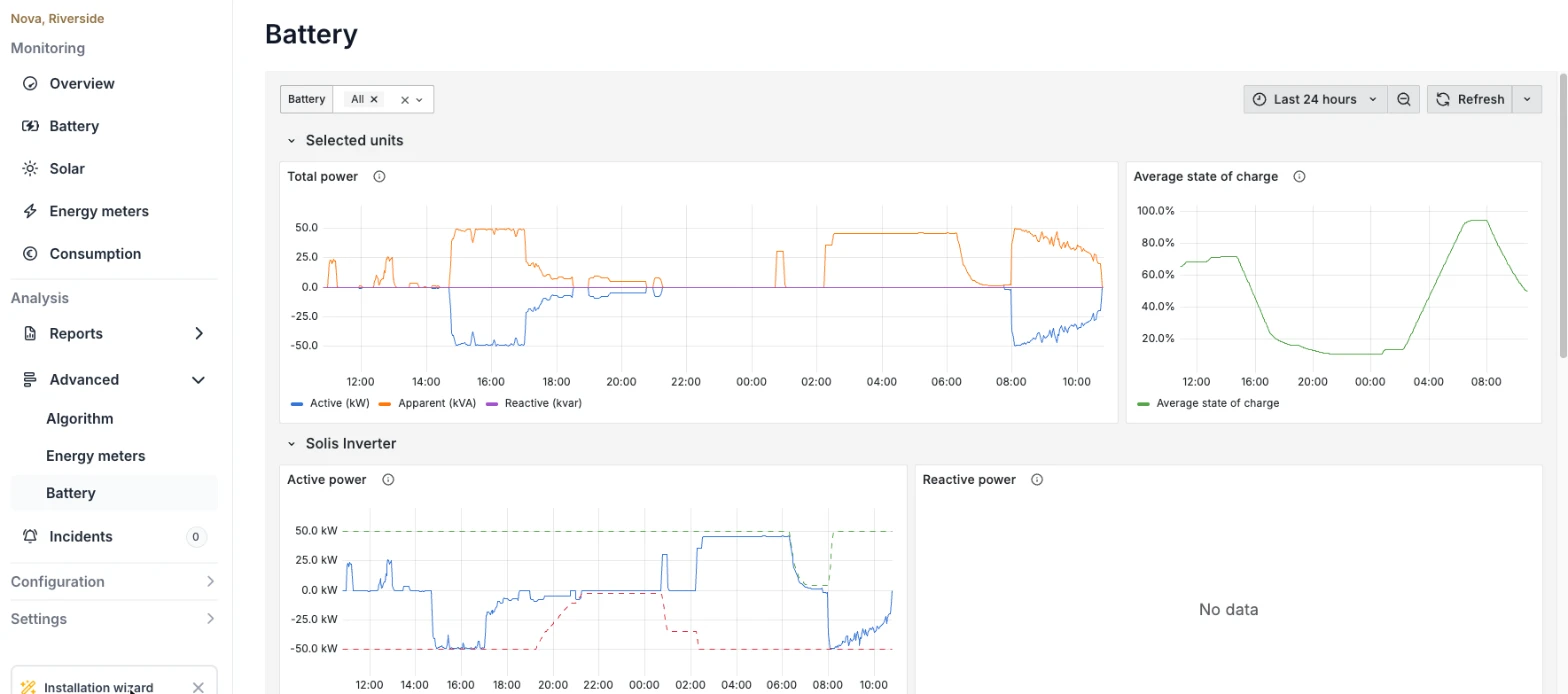
Use the Battery selector at the top to choose the units, or All. The dashboard then shows, over the selected period:
- Selected units: the Total power of the selected units (active, apparent and reactive) and their Average state of charge.
- A section per unit with:
- Active power against the setpoint of the EMS and the charge and discharge limits;
- Reactive power against its setpoint;
- Apparent power and power factor;
- State of charge with its minimum and maximum, and the Available energy;
- Power per minute: the average, minimum and maximum of every minute, so a short peak stays visible;
- Run state and Grid mode over time;
- Temperatures.
- A collapsed section with the raw registers per unit: phase voltages, currents, power and power factor per phase, frequency, temperatures, DC voltage and current, and cell voltages.
- A collapsed section BMS units with the raw DC voltage, DC current, cell voltages and temperatures of every BMS of the project.
Click the title of a collapsed section to open it.
The general state of the battery, the charged and discharged energy and the components are on the regular battery dashboard.
Frequently asked questions
Why does a chart show No data?
Not every battery inverter reports every value. A unit that does not report, for example, a reactive power or a register the dashboard looks for shows No data in that chart. The dashboard also needs advanced logging on the EMS controller.
Why do the raw values look too high or too low?
The raw registers are shown as the device reports them, without scaling. Read them for their course over time rather than as exact values in V, A or °C.