Voltmasters Platform
Strategy
The strategy of a Voltmasters EMS project: cost optimisation or self-supply, grid power, the battery, selling through the battery and the load shedding priorities.
Found under Configuration → Strategy.
Choosing a strategy
The strategy determines the primary objective of the battery and controllable devices.
| Strategy | Description |
|---|---|
| Cost optimisation | The EMS buys and sells energy at the most financially favourable times, based on EPEX day-ahead prices and your energy contract. Best suited for dynamic energy contracts. |
| Self-supply | The battery is used primarily to maximise self-consumption of locally generated energy (PV). Grid interaction is minimised. |
| No control | The EMS does not actively control the battery or other devices. |
Grid power
Grid power dead zone
A small power band around zero within which the EMS does not make control adjustments. This prevents constant small corrections and unnecessary wear on controllable equipment. A common value is 0.5 kW.
When a grid power target is configured, this band is centred on that target instead of on zero.
Grid power target
The grid power the battery balances towards instead of 0 kW. Leave it at 0 kW to keep the connection balanced to zero, which is the right value for an ordinary installation.
A positive value keeps that much import standing. Use it on sites where an external device curtails solar production to prevent injection: the extra charging shows up as import, which makes that device release more production, which the battery then stores. This repeats until production can no longer follow, and the import settles at this value.
Keep the value small, in the order of a few kW. Whenever production runs without a surplus left to release, the target is simply bought from the grid. See grid power target for the full mechanism and a worked example.

A grid power target of 4 kW, applied only while the installation is generating.
Grid power target only while producing
Determines whether the target applies around the clock or only while the installation is generating.
| Setting | Behaviour |
|---|---|
| On (recommended) | The target is capped at the current on-site generation, so it drops to 0 kW when nothing is being produced and no import is bought overnight. Generation below the target still builds up, because every step releases more production. |
| Off | The target is held around the clock, so the site keeps importing it at night and whenever there is nothing to release. |
Both fields require an EMS controller running version 0.0.323 or newer. On an older controller they stay hidden, because the balancing logic that aims at the target is not present there.
Battery
Peak shaving reserve
A percentage of the battery's state of charge (SOC) that is reserved to keep the grid import below its limit. As long as the SOC is above this reserve, the battery is used freely by the active strategy. Below it, discharging for other purposes is blocked and the reserve is refilled with priority, but the battery may still discharge to hold the grid at its import limit, for any load (general consumption as well as DC fast charging).
Set this value if the installation must never exceed its grid import limit (for example a limited transformer or connection capacity), or if part of the battery capacity must always remain available for DC fast charging. See peak shaving reserve for how it works.
Battery load balancing strategy
Determines how power is distributed across multiple battery inverters when more than one is present.
| Mode | Description |
|---|---|
| Cascade | Battery inverters are activated one by one as more power is needed. The activation order rotates regularly to spread wear evenly across all units. |
| Pro Rata | All batteries operate simultaneously. The required power is distributed proportionally based on each battery's remaining usable capacity (kWh), within the maximum charge and discharge rates of each unit. |
Selling
Minimum price difference
The minimum margin between the buy and sell price, in €/MWh, that must exist before the EMS will trade energy via the battery. A common starting value is €20/MWh. You can adjust this threshold to make the system more or less active in price-based trading.
Selling via battery injection
When this option is enabled, the EMS is permitted to discharge the battery and inject the stored energy into the grid when the injection price is sufficiently favourable.
Enable this when using the Cost Optimisation strategy with a dynamic energy contract, if you want the system to generate revenue by selling stored energy. When disabled, the EMS will not plan or execute injection sales via the battery based on energy prices.
Grid charging for injection
When this option is enabled (in addition to Selling via battery injection), the EMS may also buy energy from the grid during cheap periods purely to sell it back at moments with a high injection price. Purchases are only planned when the injection price beats the purchase price after round-trip losses plus the minimum price difference, so every buy/sell pair is profitable on its own.
Enable this when the spread between cheap hours and injection peaks in your contract is large enough to make pure price arbitrage worthwhile. When disabled, the EMS only sells energy that is already in (or naturally flows into) the battery. See Selling energy to the grid for how the two options work together.
Load shedding priorities
Below the strategy form you set the order in which the EMS sheds consumption when the grid import has to be limited. The order applies to the whole project: to the import limit protection and, with Microgrid, to island operation.
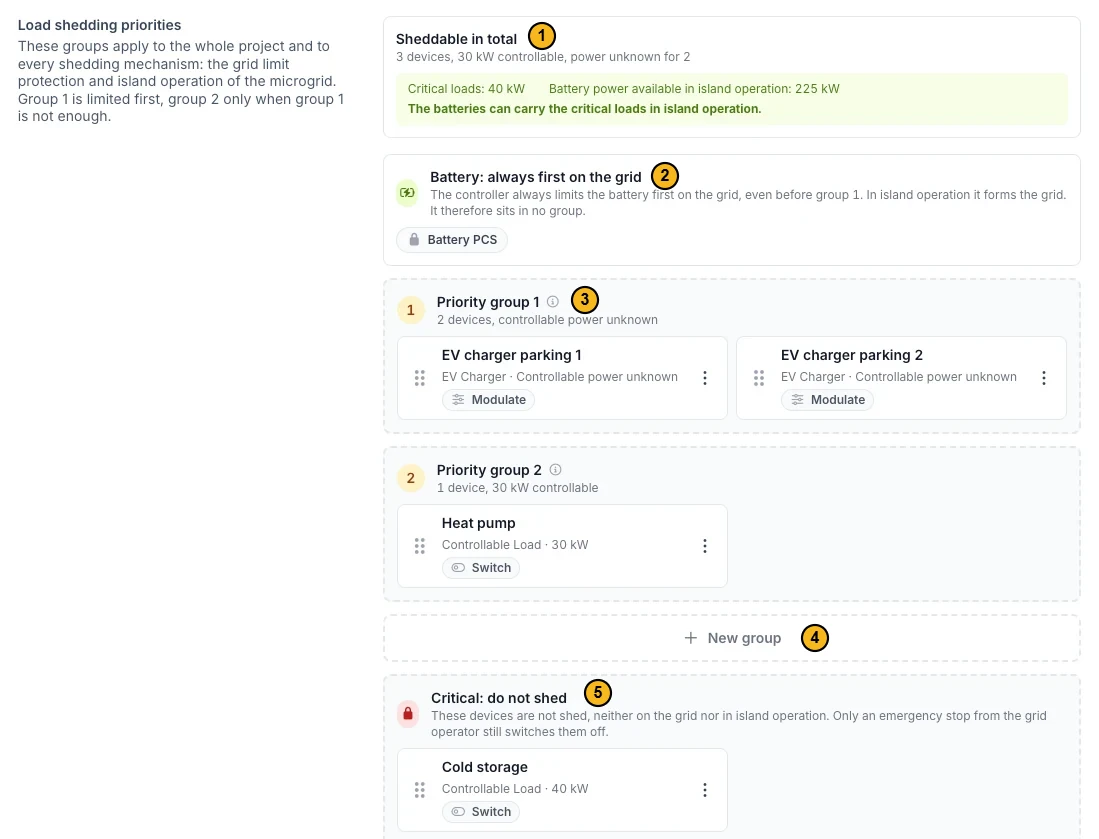
- The total that can be shed. With Microgrid on, it also shows whether the batteries can carry the critical loads in island operation.
- The battery sits outside the groups: on the grid it is always limited first.
- The priority groups. Group 1 is limited first, group 2 only when group 1 is not enough. Drag devices between groups or use the menu on a device. Within a group, EV chargers go before switched loads.
- New group adds a group.
- Critical: do not shed: these devices are never shed. Only an emergency stop from the grid operator still switches them off.
The order only reaches the controller after Save priorities. As long as the list shows Default order, the controller uses its own order: EV chargers first, then the other loads.