Microgrid
Incidents
The incidents a Voltmasters microgrid raises: grid loss, reconnection, island overload, PV, battery inverter and generator, and what to do about each.
The controller raises an incident when the microgrid changes state or something needs attention. They appear in the project's Incidents list, like every other incident.
Incident managementThe incident list, muting and notifications.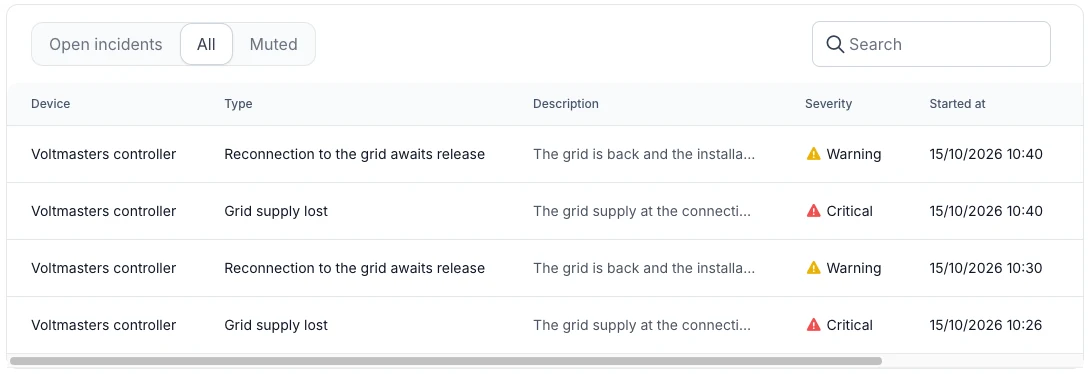
Two outages in the incident history: each time a grid loss, followed by a reconnection that awaited release.
Notified immediately
These five are sent as emergency notifications, by email and mobile push, because somebody has to know or act right away.
| Incident | What it means | What to do |
|---|---|---|
| Grid supply lost | The grid fell away. The site runs as an island on the battery, and on the generator once the state of charge drops. | Nothing: the site keeps running. Follow it on the live energy flow. |
| Reconnection to the grid awaits release | The grid is back and the site is ready to reconnect. | Release the reconnection at a suitable moment. |
| Reconnection to the grid was aborted | The reconnection did not complete. The site stays an island. | Check the reason in the banner, then release again. |
| Island is overloaded | The site draws more than the battery and the generator can supply, and there is no load left to shed. The island can trip. | Switch off consumption by hand. |
| Grid breaker closed while the generator formed the island | The grid breaker closed while the generator formed the island on its own, possibly onto a generator not synchronised with the grid. The EMS never closes the breaker then, so it was closed from outside. The EMS asks every connected generator to open its breaker and stop, and holds the microgrid logic until none is connected or the grid breaker opens again. The incident stays open for at least 15 minutes. | Have the interlock of the grid breaker, its position feedback and the grid meter checked on site. |
Other microgrid incidents
| Incident | What it means | What to do |
|---|---|---|
| Microgrid mode fault | The microgrid logic ended in a fault and no longer switches modes on its own. | Contact your installer or Voltmasters support. |
| PV limit may have failed in island mode | A PV inverter cannot be read in island operation, so its limit may not hold. The EMS takes the PV off the island until every inverter reports again. | Check the PV inverter's communication. Without a wired PV release the EMS cannot take the PV off. |
| Battery inverter is off while on the grid | The site cannot fully switch to island operation at the next outage. | Contact your installer. Mute the incident if the inverter is off on purpose. |
| Generator no longer controllable | A started generator keeps running but no longer follows the controller. The EMS asks it to stop, unless the island depends on it. | Have the generator checked on site. |
| Generator did not come online after its start | The generator did not connect in time. The island runs on the battery alone until a new attempt succeeds. | Check the generator if it repeats. |
| Generator failed to synchronise | The generator breaker did not close because synchronisation failed. | Check the generator if it repeats. |
| Reverse power on the generator | Power flows into the generator. Its controller may open its breaker. | Have the generator settings checked. |
| Generator start is held back | The generator is needed, but the battery cannot absorb its minimum load yet. It starts as soon as there is room. | Nothing. |
| Generator forms the island instead of the battery | The generator forms the island on its own: the battery inverters are off, in fault or not responding, the battery ran empty, or the generator already held the bus when the grid was lost. With a PV release, the EMS keeps the PV off the island meanwhile. The battery only takes over once the generator no longer holds the island. | If the battery should be available, have it checked. |
| Battery inverter does not rejoin the island | A battery inverter dropped out of the island the other inverters keep forming, and the EMS could not bring it back. The island runs with less battery power. The EMS keeps trying; the message names the inverter and why the last attempt failed. | Have the inverter and its battery checked on site. |
| Synchronised reconnection to the grid failed | A synchronised reconnection ended without the grid breaker closing. The battery keeps forming the island. The next release synchronises again or reconnects through a dead bus, with an interruption; the incident says which. | Check the synchrocheck relay, its settings against the microgrid settings, and the closing circuit of the grid breaker. |
| Synchronised reconnection to the grid unavailable | The site is set up to reconnect synchronised, but has not been able to for at least 15 minutes, for example because the grid breaker release or the bus meter is missing or the meters are not calibrated against each other. Until then, a reconnection goes through a dead bus, with an interruption. | Have the cause named in the incident fixed. The EMS calibrates the meters itself while the site runs on the grid. |
The alarms of the generator controller itself also appear as incidents, each under its own name: for example crank failure, low oil pressure, a service timer, a failed starter battery test or starter battery asymmetry, DC supply undervoltage or overvoltage of the generator controller, a switchboard error, a tripped non-essential load group, a fault of the digital AVR, or a diagnostic code from the engine control unit. The explanation of each incident says what to have checked.