Microgrid
Overview
How the Voltmasters EMS keeps a site powered during a grid outage, with the battery, a generator and a controlled return to the grid.
With Microgrid, the Voltmasters EMS keeps a site powered when the public grid fails. The controller separates the site from the grid, the battery forms a local grid of its own (island operation) and, when needed, a generator takes over. When the grid comes back, the controller reconnects the site safely and in a controlled way.
What the customer gains
- Continuity: the business keeps running during a grid outage, without anyone on site.
- Critical loads stay powered: the customer chooses what may never be switched off (cold storage, servers, process). The rest is shed in order of priority.
- The generator only when it is needed: it starts when the battery runs low, not at every outage. Fewer running hours, less fuel.
- A battery that earns its keep in normal times: on the grid the battery keeps optimising energy costs. It only holds back a reserve for a possible outage.
- Everything is visible: live status, notifications and a report on grid availability and generator use.
How it works
On the grid: the battery stands ready
The site runs normally. The controller keeps an island reserve in the battery (50 % by default), so there is always energy available when an outage hits.
The grid fails: the site switches to island operation
The controller opens the grid breaker and the battery forms the site's grid. The switchover causes a short interruption, after which the site runs on its own on the battery and the solar panels. If consumption exceeds what the battery can deliver, the controller sheds the non-critical loads in the chosen order.
The battery runs low: the generator starts
Below a state of charge threshold (20 % by default), the controller starts the generator. The generator then forms the grid, powers the site and recharges the battery. Above the stop threshold (90 % by default), the generator stops again.
The grid returns: controlled reconnection
The controller waits until the grid voltage and frequency are stable, then reports that the grid is back. Reconnecting causes a short interruption (at most two minutes when the battery forms the grid). That is why a responsible person releases it with one click, at a suitable moment, in the platform or the mobile app. The site can also reconnect automatically.
A complete outage in seven steps. Watch who forms the grid: blue for the grid, green for the battery, pink for the generator.
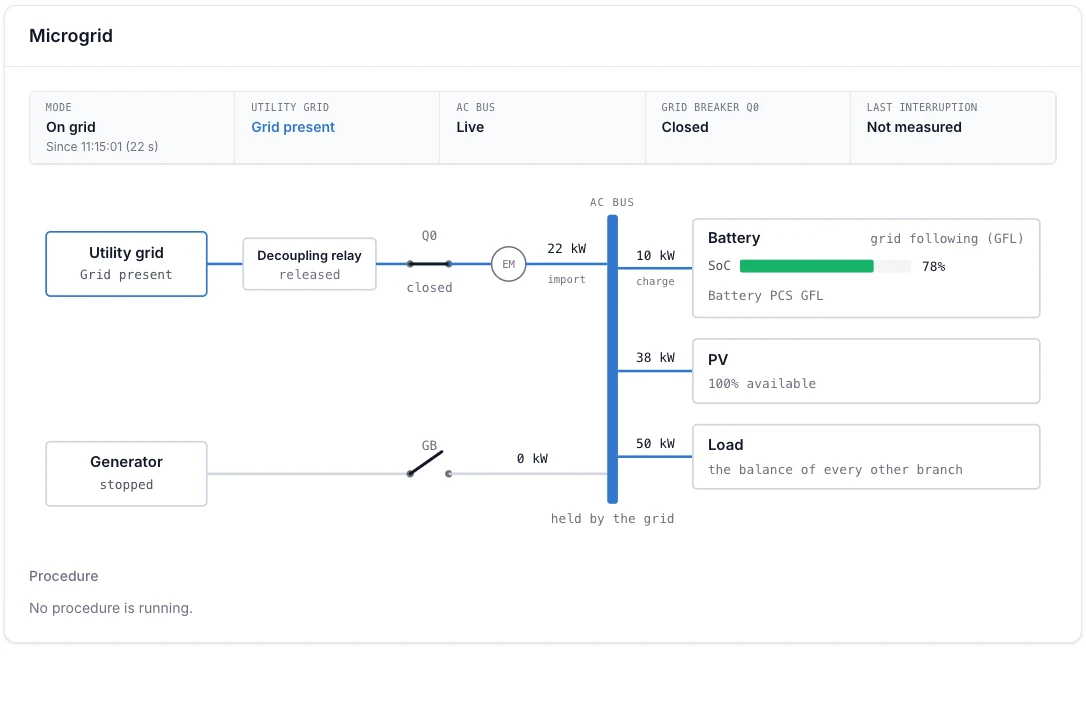
On the grid: the battery stands ready
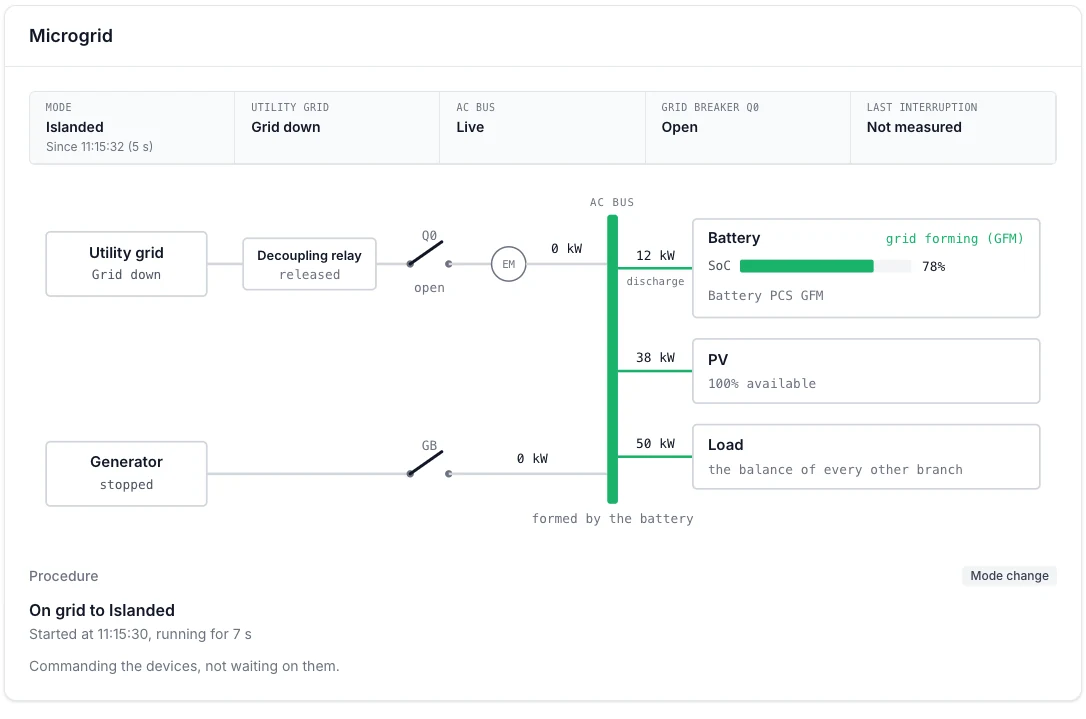
The grid fails: the battery forms the island
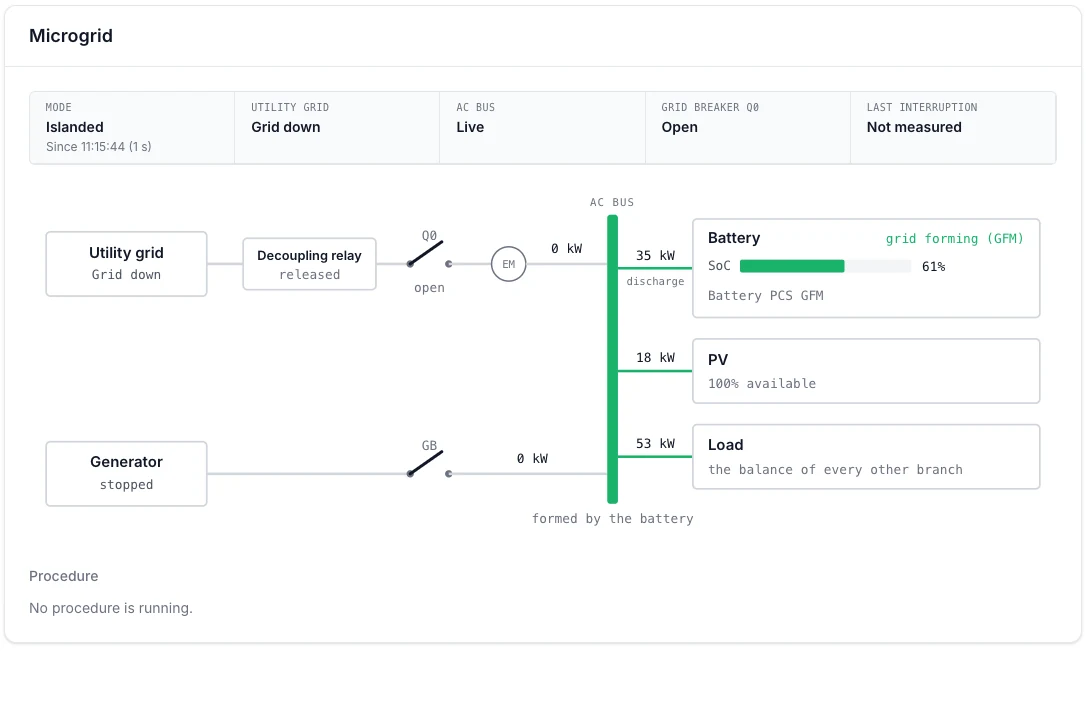
Island operation on the battery
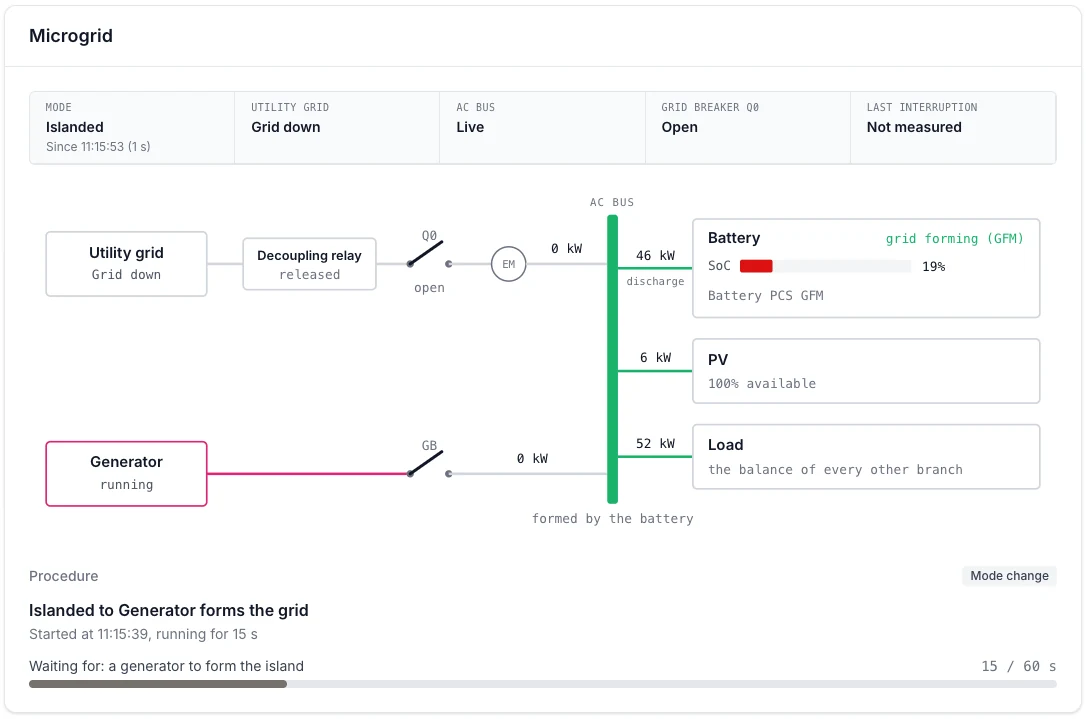
Battery low: the generator starts
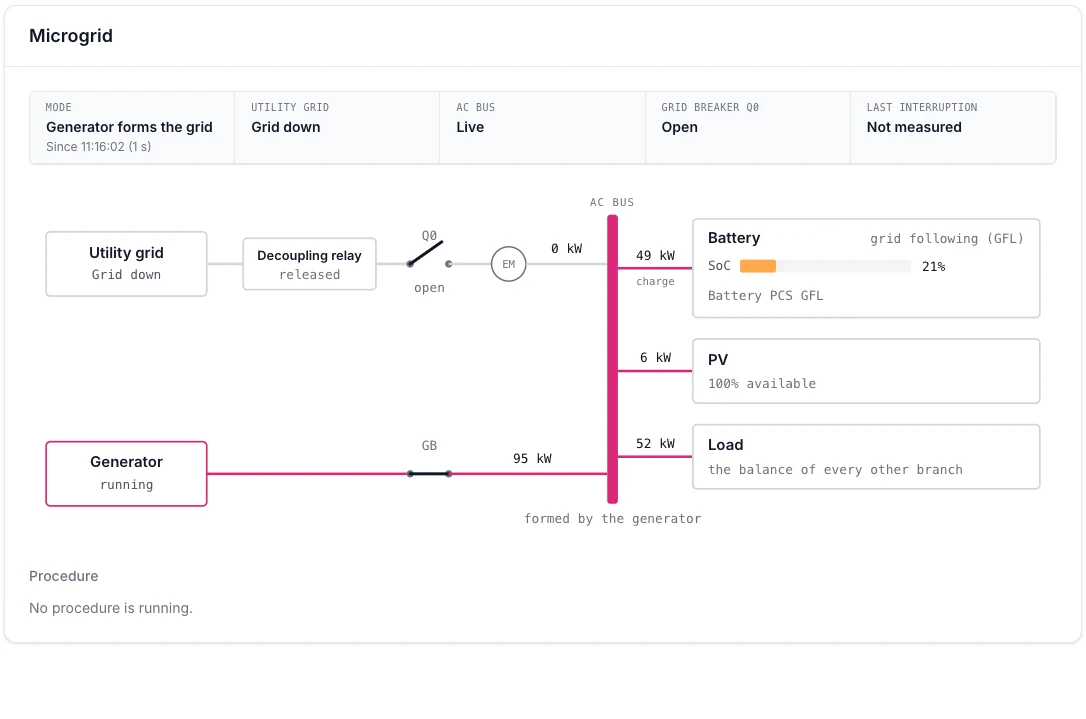
The generator forms the grid and charges the battery
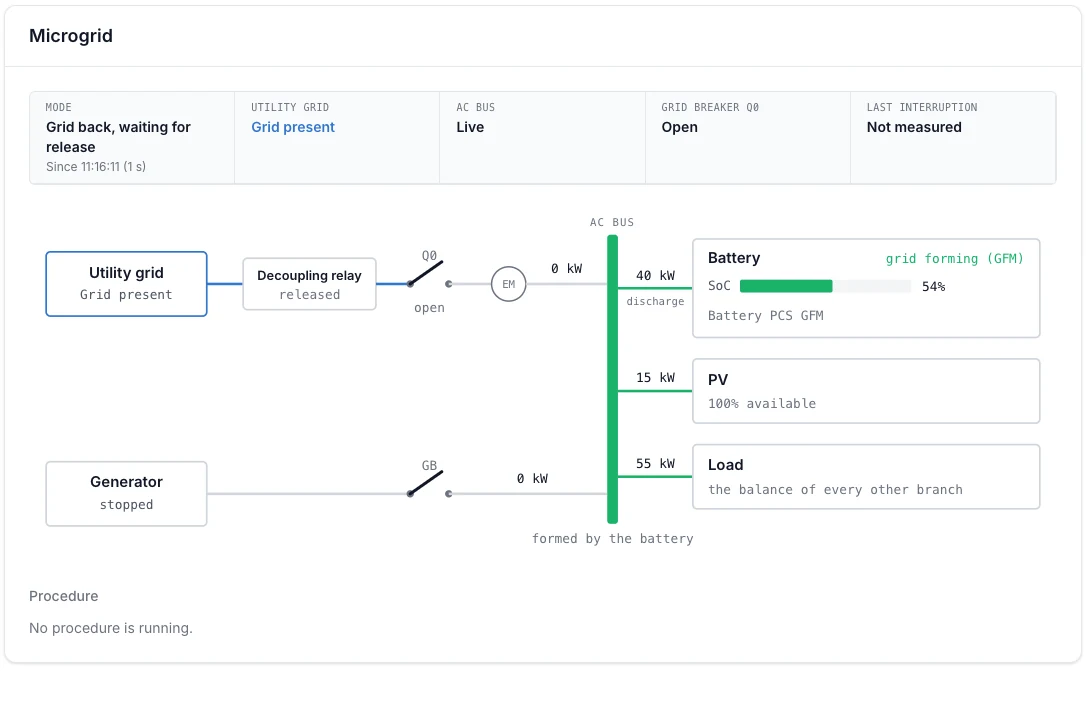
The grid is back: waiting for release
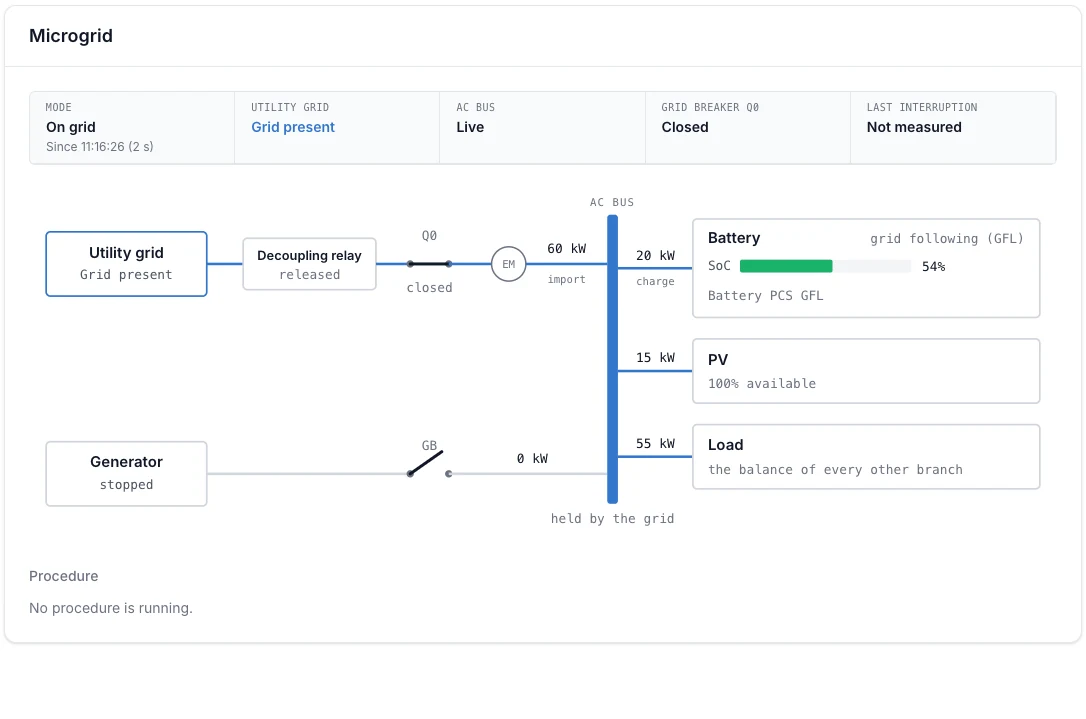
Reconnected: back on the grid
What the customer sees
- A live single line diagram on the project dashboard: who forms the grid, the breaker positions, the power flows and the current step of every procedure.
- Notifications when the grid fails and when it returns, with the Release reconnection button in the platform and a push notification in the mobile app.
- The microgrid report: grid availability, outages, reconnections, generator running hours and energy, fuel cost, with a CSV export.
What the site needs
| Component | Role |
|---|---|
| Voltmasters controller | Runs the whole sequence: outage detection, island operation, generator, load shedding and reconnection. |
| Battery with a grid-forming inverter | Forms the site's grid during island operation. |
| Grid breaker with position feedback, and a decoupling relay | Separates the site from the public grid and confirms its position to the controller. |
| IO module (Moxa ioLogik E1214) | Connects the breakers, the protection relay and the generator start to the controller. |
| Generator (optional, DEIF AGC 150) | Takes over when the battery runs low during a long outage. |
| Solar panels (optional) | Keep producing during island operation, limited to what the site can absorb. |
How this section is organized
- How Microgrid works: the operating modes and every transition between them.
- Live monitoring: the single line diagram and the procedure panel on the dashboard.
- Grid reconnection: releasing the return to the grid, step by step.
- Configuration: prerequisites, microgrid settings, IO roles, generator and load shedding.
- Microgrid report: outages, reconnections and generator use over a period.
- Incidents: the notifications Microgrid raises.
Microgrid is enabled per project, after Voltmasters has validated the installation.