DSO RTU
How an activation works
What the Voltmasters controller does during a Fluvius Fall-Back Flex activation: the target with safety margin, the order in which devices are held back, the release and the behaviour when something fails.
This page describes what the controller does from the moment Fluvius sends a limit until the limit is lifted. For the overview, see Fall-Back Flex.
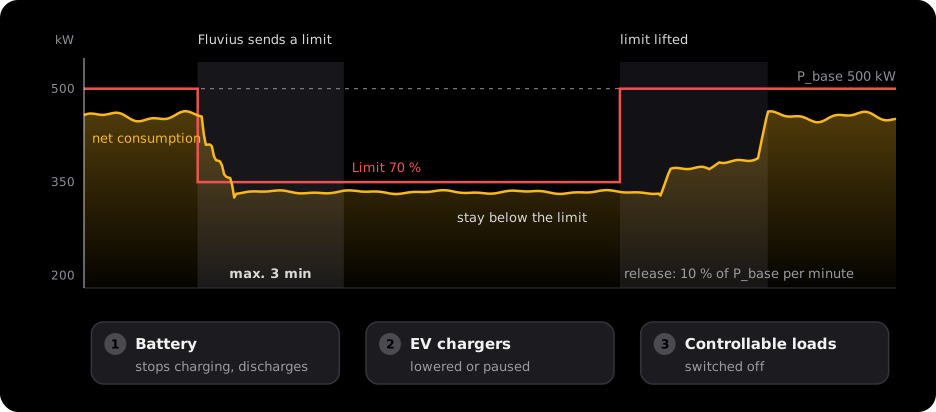
Hold back in order, stay below the limit, release in reverse order.
1. The limit arrives
- Fluvius sends
MAXSETPthrough the Netflex RTU. The controller confirms it and echoes it back to Fluvius. - Limit in kW =
MAXSETP× P_base. 100 % or more means no limit. - The response time of 3 minutes starts when a limit comes into force or gets stricter. A looser limit does not restart it.
- The reason code (1 congestion, 99 test) is informative only. A test is followed like a real activation.
2. The target
The controller steers to a target just below the limit, so meter noise and short peaks do not push the quarter-hour average over it.
Target = limit − safety margin, with a safety margin of 2 % of P_base and at least 5 kW.
Example: P_base 500 kW, limit 70 %. The limit is 350 kW, the margin 10 kW, so the controller steers to 340 kW.
3. Order of the devices
The controller only removes the excess: the expected net consumption above the target. It works through the devices in a fixed order and goes to the next one only when the previous one is not enough.
| Order | Device | What happens |
|---|---|---|
| 1 | Battery | Charging stops first. If more is needed, the battery discharges to cover the site's consumption, down to its minimum state of charge. |
| 2 | EV chargers | Charging sessions are lowered, down to their minimum charging power. After that, connectors are paused one by one, lowest connector priority first. |
| 3 | Controllable loads | Switched off entirely, one by one. The load with the lowest Priority setting goes first (10 before 1). A load without a nominal power does not take part. |
- After every step the controller waits until the change shows in the grid measurement (at least 5 seconds) before it goes further.
- A device that does not follow its new setpoint within 30 seconds is counted at its measured value, and the controller moves on to the next device.
- During an activation the limit takes precedence over the battery strategy: a charge plan or a trading signal cannot make the battery charge.
4. Holding
As long as the limit applies, the controller keeps watching the grid meter:
- consumption rises (a machine starts): it holds back more devices;
- consumption drops: after 60 seconds of room it gives power back, one step at a time.
5. Release
When Fluvius lifts or relaxes the limit, consumption comes back gradually:
- the first step 60 seconds after the end, then one step per minute;
- each step at most 10 % of P_base;
- in reverse order: loads first, then EV chargers, the battery last;
- a load only comes back when there is room for its full nominal power.
| Minimum time | Value |
|---|---|
| A switched-off load stays off for at least | 5 minutes |
| A load that was switched on runs for at least | 1 minute |
| A paused EV connector stays paused for at least | 2 minutes |
| A resumed EV connector charges for at least | 2 minutes |
Emergency stop consumption
When Fluvius sends the Netflex emergency stop consumption, the controller sets all flexible consumption to zero at once: battery charging, EV charging and controllable loads. Minimum times do not apply. The battery is not forced to discharge.
When something fails
| Situation | What the controller does |
|---|---|
| The RTU link drops | Keeps applying the last limit, also after a restart. A limit only changes when Fluvius sends a new one. |
| No internet | Nothing changes: the controller and the RTU work locally. |
| No usable grid measurement | Keeps the devices where they are and raises an incident. |
| No P_base configured | Cannot convert the percentage into kW, keeps the devices where they are and raises an incident. |
| All devices held back, still above the limit | Raises Fall-Back Flex has no flexibility left while consumption still exceeds the limit. |
See Incidents and notifications.
With technical flex as well
On a connection that also has technical flex, a battery in the registered asset group is only discharged as far as the asset setpoint (MINSETAP) allows. The controller respects both orders and covers the rest with the other devices.
How Fluvius judges compliance
- Per quarter hour, on the billing meter at the connection point.
- A quarter hour with the net consumption at or below the limit counts as delivered.
- Consumption above the limit is accepted during the 3-minute response time.
The platform shows the same view in the activation history.