Voltmasters Platform
Network check
The Network check tells you whether the EMS controller reaches the platform, the measurement database, the time and name servers and remote access.
The Network check tells you whether the EMS controller can reach the Voltmasters services it needs: the platform, the measurement database, the time servers, the name servers, the software update sources and the remote access service. It sits under Configuration → EMS controller → Network configuration, below the network configuration itself.
The controller performs the check itself, from its own network position, so the result reflects what the controller can reach and not what your laptop can reach.
This check says nothing about the connected devices. It only tests the outbound connections to the services on the internet. A green verdict means the controller reaches Voltmasters, not that it reaches your inverter, battery or meter. Whether the link to a device works is shown by the connection test on that device's Communication tab, and by the values the device reports. See Device settings.
Running the check
Press Run network check. The controller runs through the targets and reports back, which takes up to half a minute. Then open View results; the results stay available under that button until you run the check again.
The check only tests connections. It changes nothing on the controller and nothing in the installation, so it is safe to run at any time.
Reading the results
The result opens with a verdict in one line, either that the controller reaches everything it needs, or that it does not and the recommendations below apply. Underneath, the individual targets are grouped by what they are for, each marked OK or Not reachable:
| Group | What it covers | If it fails |
|---|---|---|
| Name resolution (DNS) | Resolving the names the controller connects to. | Allow DNS traffic on port 53, over both UDP and TCP, and make sure no filter blocks the listed names. |
| Time synchronisation (NTP) | Keeping the controller's clock right. | Allow outbound NTP traffic on UDP port 123. Without a correct clock the controller cannot communicate with the platform at all. |
| Platform and measurement data | The connection that carries measurements to the platform. | Allow outbound TCP traffic to the measurement database. Without it no measurements arrive. |
| Software updates | Fetching operating system updates. | Allow outbound TCP traffic on port 80 to the Ubuntu package sources. |
| Remote access | The link that lets Voltmasters Support inspect the installation. | Allow outbound TCP traffic on port 443 to Tailscale. |
Only the failing groups get a recommendation, and each recommendation lists the exact addresses involved, with the protocol named alongside the port. TCP 53 and UDP 53 are separate firewall rules, so the results keep them apart and the recommendation can be handed to a network administrator as it stands.
A target the controller never answered for counts as not reachable. A group is only OK when every target in it is reachable.
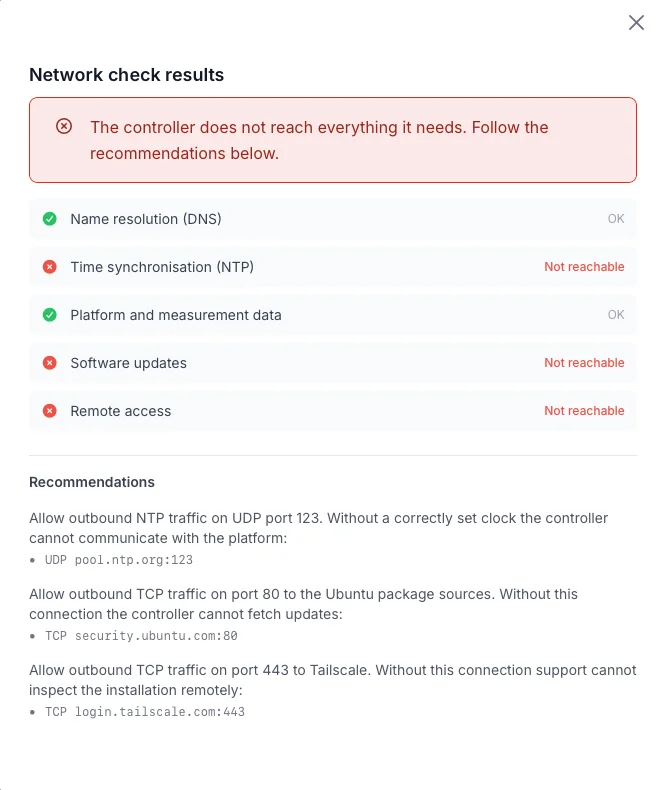
A controller that reaches the platform but not the time servers, the package sources or the remote access service.
Extra checks
Above the button, under Extra checks, you can add your own targets to the run: another internet service the installation depends on, or an address on the local network you want to prove the controller can open a connection to. Every extra check needs a type:
| Type | What you fill in | What it tests |
|---|---|---|
| TCP | Host and port | Whether a TCP connection to that host and port is established. |
| UDP:DNS | Host and port | Whether a DNS query over UDP gets an answer. |
| UDP:NTP | Host and port | Whether a time server answers over UDP. |
| UDP:STUN | Host and port | Whether a STUN server answers over UDP, as Tailscale needs for NAT traversal. |
| DNS | Host | Whether that name resolves. |
| HTTP | Full URL | Whether that URL answers. |
UDP has no connection to establish, which is why a plain UDP port test says nothing: only a protocol that actually answers proves that the traffic gets through. That is what the three UDP types are for.
Extra checks are reported separately from the groups, one line per check, under Extra checks in the results. They belong to that run only: they are not stored and are gone when you leave the page. When the default services are all reachable but an extra check fails, the verdict says so explicitly.
Who sees this
The network check is available to Voltmasters administrators and to installers with access to the project. Clients of a project do not see the tab.
Run the network check at commissioning, before you start looking for device problems. A controller behind a restrictive firewall produces symptoms that look like device faults, and this check rules that side out in half a minute. What it rules out is the internet side: if the check passes and devices still report nothing, look at the device links themselves. For the full list of ports and domains, see Internet and network.