Device integrations
Sungrow
Sungrow inverters in the Voltmasters EMS: which series support Modbus TCP and curtailment, and how to connect them.
Sungrow is a global leader in solar inverter and energy storage solutions.
Within our EMS, we support a wide range of Sungrow inverters for monitoring, control, and energy management.
The following Sungrow devices are compatible with and supported by our EMS for communication and integration.
| Device Type | Modbus TCP (Ethernet) | Curtailment | ||
|---|---|---|---|---|
| SG-Series | ✅ | ✅ | false | |
| S-Series | ✅ | ✅ | false | |
| SR-Series | ✅ | ✅ | false | |
| MVS-Series | ✅ | ✅ | false | |
| ST-Series | ✅ | ✅ | false | |
| SH-Series | ✅ | ✅ | false | |
| SBR-Series | ✅ | ✅ | false | |
| SC-Series | ✅ | ✅ | false |
Physical connection
Network configuration
Ethernet configuration
To configure the inverter for Ethernet communication:
- Open the inverter display interface
- Navigate to:
- Settings → Communication Parameters
- Enable MODBUS-TCP
- Set the communication port:
- Default Port: 502
- Configure:
- DHCP, or
- A static IP address depending on your network requirements
Device configuration
Enable Modbus communication
- Open the inverter LCD display
- Navigate to:
- Settings → Communication Parameters
- Configure the following settings:
| Parameter | Value |
|---|---|
| Protocol | MODBUS |
| Device Address | Unique address between 1–247 |
Modbus TCP Settings
| Parameter | Value |
|---|---|
| MODBUS-TCP | Enabled |
| Port | 502 (default) |
| IP Address | According to network configuration |
Important issue
Known issues
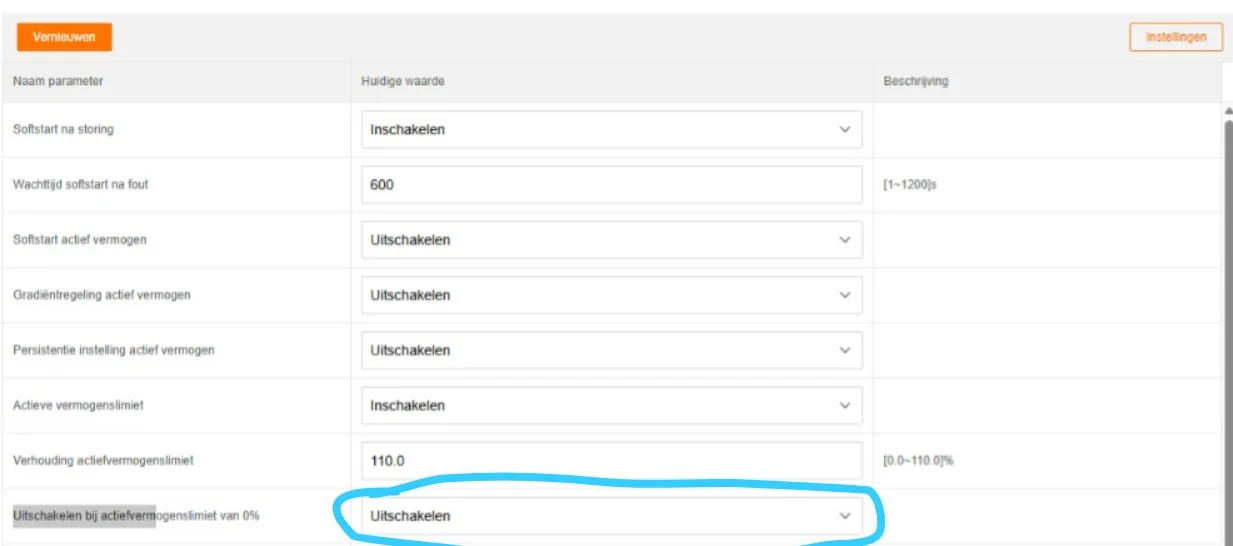
Inverter goes offline after receiving a setpoint of 0
Some Sungrow inverter models stop communicating with the EMS for an extended period after the EMS sends a power setpoint of 0 kW (for example, during curtailment at negative energy prices). The inverter enters a low-power or sleep state and does not immediately respond to new commands.
Workaround: If this behaviour occurs on your installation, contact Voltmasters Support. A configuration adjustment may be required to prevent the inverter from entering this unresponsive state during zero-setpoint periods.