DSO RTU
RTU connection
The network link between the grid operator's RTU and the controller, and what is needed on site to establish it.
A DSO RTU connection relies on a data link between an RTU (Remote Terminal Unit), installed on site by the grid operator, and the Voltmasters controller. This page explains that link, how the RTU is physically connected, and what has to be prepared on site.
Roles
- The RTU is supplied and installed by the grid operator. It is the grid operator's equipment and its endpoint inside their control infrastructure. The grid operator is responsible for the RTU and for the connection from the RTU back to their control centre.
- The controller is the client interface. It is the single point through which the grid operator monitors and controls the installation. The controller exposes a standardized DSO RTU interface that the RTU connects to.
The DSO RTU protocol and its parameters, such as the network port, are operator-specific. See the grid operator's page under Grid operators for the exact protocol details.
Physical connection
The RTU is connected to the controller with a network (Ethernet) cable. On the controller side, that cable is plugged into an Ethernet-to-USB adapter:
- The grid operator's RTU provides an Ethernet port. Run a network cable from the RTU to the controller.
- Plug that cable into the Ethernet-to-USB adapter on the controller. Any USB port on the controller can be used; the adapter is detected automatically regardless of which port it is in.
- This gives the controller a dedicated network interface for the DSO RTU link, separate from its normal internet connection.
RTU ──Ethernet cable──► Ethernet-to-USB adapter ──► Controller (any USB port)
Fluvius connection
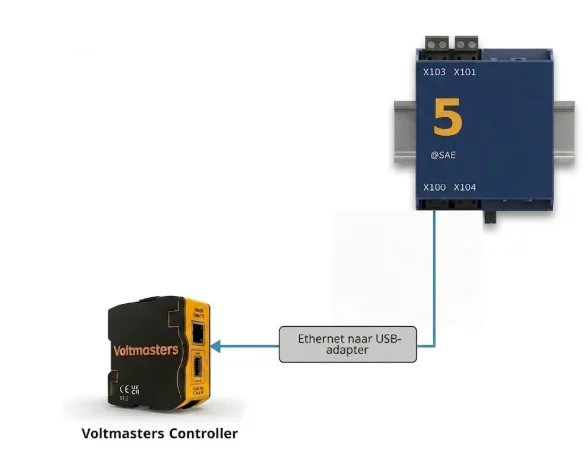
Connect the Voltmasters controller to the X100 port of Fluvius RTU
Network
- The link between the RTU and the controller is a local, dedicated link over the Ethernet-to-USB adapter; it does not require internet access.
- The controller still needs its own internet connection for the Voltmasters platform; see Internet and network. That connection is separate from the DSO RTU link.
- Over this link the RTU and the controller exchange data using the grid operator's DSO RTU protocol over TCP/IP.
What is exchanged over the link
| Direction | Content |
|---|---|
| Grid operator → controller | Active-power limits, reactive-power band & mode, emergency stops, reason codes, time synchronization, and a request for the full current state. |
| Controller → grid operator | Confirmation and feedback of every command, and periodic measurements per asset category. |
The functional meaning of each of these is described in How DSO RTU works. The exact data points are listed on the grid operator's page.
Link health and monitoring
The controller continuously monitors the DSO RTU link. If DSO RTU is enabled but there is no active connection from the RTU, the controller raises an incident so the situation is visible on the platform. This typically means the RTU cannot reach the controller (cabling or adapter issue) or the RTU is not (yet) active.
See Incident management for how incidents are surfaced and handled.
Preparation checklist
Before commissioning the RTU link, make sure:
- [ ] The grid operator has scheduled the RTU installation.
- [ ] A network cable runs from the RTU to the controller.
- [ ] An Ethernet-to-USB adapter is connected to the controller.
- [ ] The contractual grid limits (max injection / consumption) are known and configured in the project.
Voltmasters validates the full link during commissioning.