Companies requesting a new or heavier connection in a congestion zone today are increasingly offered a formula that was rare until recently: Fall-Back Flex. That is no coincidence. In late April the Flemish utility regulator relaxed the conditions under which Fluvius may offer the formula. According to the grid operator, that is a breakthrough for 760 waiting dossiers from businesses that would otherwise have waited years for a grid investment.
What is Fall-Back Flex?
Fall-Back Flex is a temporary connection formula from Fluvius for businesses of 100 kVA or more in zones where grid congestion is expected. The principle is simple:
- The business gets its full requested power right away.
- Only when the local grid is under pressure does Fluvius temporarily send a limit (a setpoint).
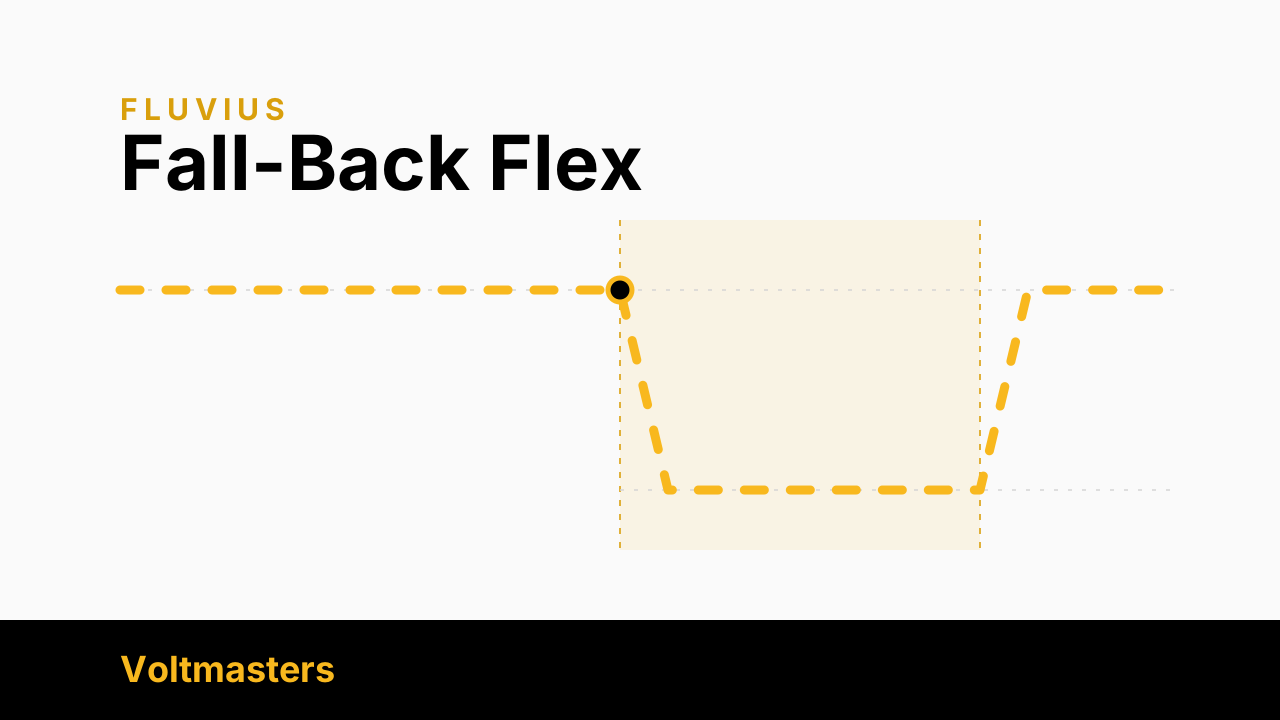
Outside congestion nobody notices anything: the installation runs at the full requested power. When Fluvius sends a setpoint, the installation must ramp down within 3 minutes and stay below the limit until the signal is released. After that it simply returns to full power.
Why now?
In parts of Flanders the electricity grid has hit its limits. New or upgraded connections of 100 kVA or more ended up on a waiting list there until the necessary grid investment was carried out, which can take years. Fall-Back Flex already existed as a way out, but Fluvius was only allowed to offer the formula in zones where Elia had already planned a concrete grid reinforcement.
In late April the Flemish utility regulator dropped that one-to-one coupling between a request and a planned grid investment: the investment or another concrete solution now has to be included in the next investment plans, but no longer has to be fully worked out in advance. Since then Fluvius has been sending tailored quotes for the hundreds of dossiers that were stuck.
Battery projects are moving too: around 500 applications for industrial batteries are waiting for a quote, about a hundred of which can only connect through Fall-Back Flex. A separate regulatory decision on connection contracts for batteries is expected in the coming months.
What does this mean for businesses?
The upside is clear: connect at full power right away instead of waiting years. In return comes a commitment that is demanding, both contractually and technically:
The Fluvius requirements
Respond within 3 minutes
The setpoint must be reached within 3 minutes.
Respect the limit for as long as Fluvius requires
The full control period, with real-time feedback to Fluvius.
Controllable 24/7
Control actions can come at any time, at night and on weekends.
The whole installation joins in
Heat pumps, cooling units and ventilation must be able to switch along too.
There is a financial side as well. Following a control action creates an imbalance in the portfolio of the balance responsible party (BRP). The customer carries the financial responsibility for that imbalance and makes arrangements about it with their (supplier) BRP in advance; the BRP's approval is a fixed step in the application.
Finally, the formula is explicitly temporary: it lapses once the planned grid investment in the zone is carried out. Once the regulatory framework for it is finalised, it is automatically converted into a flexible connection agreement (FAO).
What does this mean for installers?
Fall-Back Flex shifts part of the design work. An installation must be able to ramp down substantially within 3 minutes without breaking operations. That makes the battery strategic: it can absorb a limit without anyone noticing. Large loads such as heat pumps, cooling units or process loads must be switchable, even when they have no communication protocol. And the full control chain must be validated and certified with Fluvius before the installation goes live.
Whoever only thinks about this after receiving the Fluvius quote ends up redesigning. Whoever takes it into account from the start delivers an installation that is compliant and that the customer never notices in daily operations.
How we fill this in
Voltmasters makes installations fully compliant with Fall-Back Flex. The Voltmaster Controller catches every signal from Fluvius automatically. If a battery is available, it absorbs the limit first; only when that is not enough does our IO extension switch off loads. We guide the certification with Fluvius from A to Z, and in the Voltmasters platform you can review every control action afterwards, down to asset level.
The chain, visualised
From Fluvius to every load, in one control chain
During congestion Fluvius sends a setpoint through the Netflex cabinet. The Voltmaster Controller treats it as a hard constraint, ramps the battery and EV charging down directly and switches protocol-less loads through the IO extension. Where the zone sheet imposes it, the day plan over the Fluvius API comes on top of that.
Everything you need to know about the requirements, the step-by-step process and the certification is on our Fall-Back Flex explainer page. A concrete project on your desk? Discuss it with us.
Sources: Fluvius press release (23 April 2026, Dutch) and decision BESL-2026-33 of the Flemish utility regulator (Dutch).