Grid compliance · Belgium · Fluvius
Fall-Back Flex: connect at full power in a congestion zone
Fall-Back Flex (also written as fallback flex) is Fluvius' temporary connection formula for businesses in zones with grid congestion. Your customer gets the full requested power; only when the local grid is under pressure does Fluvius send a setpoint through the Netflex cabinet that the installation must respect. Voltmasters EMS processes that setpoint automatically and makes the installation fully compliant with the Fall-Back Flex requirements.
What is Fall-Back Flex?
In parts of Flanders the electricity grid is at its limit. Without extra arrangements, a new or upgraded connection of 100 kVA or more could wait years for a grid investment. With Fall-Back Flex your customer can connect right away, at the full requested power, in exchange for the guarantee that the installation temporarily ramps down to a setpoint sent by Fluvius during congestion.
The control runs over telecontrol: Fluvius installs a Netflex cabinet in the customer cabin and sends setpoints over the IEC 60870-5-104 protocol. The formula is explicitly temporary: it lapses once the planned grid investment is carried out. Once the regulatory framework for it is finalised, it is automatically converted into a flexible connection agreement (FAO).
A control event, visualised
Full power, except during a congestion event
Outside congestion your customer notices nothing. When Fluvius sends a setpoint, the installation ramps down within 3 minutes and stays below the limit until the signal is released.
How the control works technically
Fluvius sends setpoints through the Netflex cabinet in the customer cabin. The Voltmaster Controller connects directly to that cabinet over IEC 60870-5-104 and treats every setpoint as a hard constraint in the optimisation: battery and EV charging ramp down in a controlled way, and through the IO extension protocol-less loads switch along too.
The chain, visualised
From Fluvius to every load, in one control chain
During congestion Fluvius sends a setpoint through the Netflex cabinet. The Voltmaster Controller treats it as a hard constraint, ramps the battery and EV charging down directly and switches protocol-less loads through the IO extension. Where the zone sheet imposes it, the day plan over the Fluvius API comes on top of that.
The Fall-Back Flex requirements, and how the EMS meets them
The Fluvius product sheet sets out a number of technical requirements. With Voltmasters EMS the installation meets every one of them, without your customer noticing anything in day-to-day operation.
Response within 3 minutes
An installation must follow a Fluvius setpoint within 3 minutes.
The Voltmaster Controller processes the setpoint immediately as a hard constraint and ramps battery, EV charging and loads down well within the time limit.
Setpoint respected for the full control period
The setpoint applies until Fluvius releases the signal, not only at the moment of the control action.
The optimisation stays below the limit for the entire period and feeds the measurements back to the Netflex cabinet in real time.
Controllable 24/7
Control actions are possible at any moment, day and night, including weekends.
The controller runs locally on the installation: the telecontrol link with the Netflex cabinet keeps working even during internet outages.
Connection of 100 kVA or more
Fall-Back Flex applies to larger (medium-voltage) connections in congestion zones.
The Voltmaster Controller is built for this installation class and comes prepared for telecontrol as standard.
Loads without a protocol join in too
Respecting a setpoint rarely works with the battery alone. Large loads without a communication protocol, think heat pumps, cooling units, ventilation or process loads, must be able to switch along during a control action.
That is what the Voltmasters IO extension is for: it controls such loads through volt-free contacts. Based on the real-time measurements the controller decides which loads switch when, so the setpoint is met with as little impact as possible on your customer's operation.
From application to commissioning
As an installer you go through a fixed process with Fluvius together with your customer. Voltmasters takes care of the technical side: the coupling, the validation and the coordination with Fluvius.
-
1
Application with Fluvius
Your customer applies for the connection; the zone sheet determines whether Fall-Back Flex applies in the zone. The bid form records the flexibility.
-
2
BRP approval
Your customer's balance responsible party gives its approval, a fixed step in the procedure.
-
3
Netflex cabinet in the cabin
Fluvius installs the Netflex cabinet in the customer cabin, the telecontrol interface of the connection.
-
4
Coupling & certification
Voltmasters connects the controller to the Netflex cabinet over IEC 60870-5-104 and guides the validation and certification, often in a single session.
-
5
In service at full power
The installation runs at the full requested power and is ready for every control action.
And afterwards?
Fall-Back Flex is explicitly temporary. Once Fluvius has carried out the planned grid investment in the zone, the formula lapses and your customer gets a regular connection. Once the regulatory framework for it is finalised, it is automatically converted into a flexible connection agreement (FAO). The telecontrol coupling you install today remains fully usable either way.
Follow-up in the Voltmasters platform
Fall-Back Flex is configured in the platform in minutes, and every control action can be accounted for afterwards down to asset level. You and your customer know exactly what happened during a congestion event.
One switch in the telecontrol settings
Fall-Back Flex is enabled as an option on the Fluvius telecontrol configuration. You only enter the reduced power (P_red) from the bid form; the contractual power (P_base) is taken from the project's grid settings.
Load shedding priorities per project
You decide which assets scale back first: the battery by default (invisible to operations), then EV charging, and switched loads only as a last resort. Drag to reorder and see immediately whether the controllable power covers the required reduction.
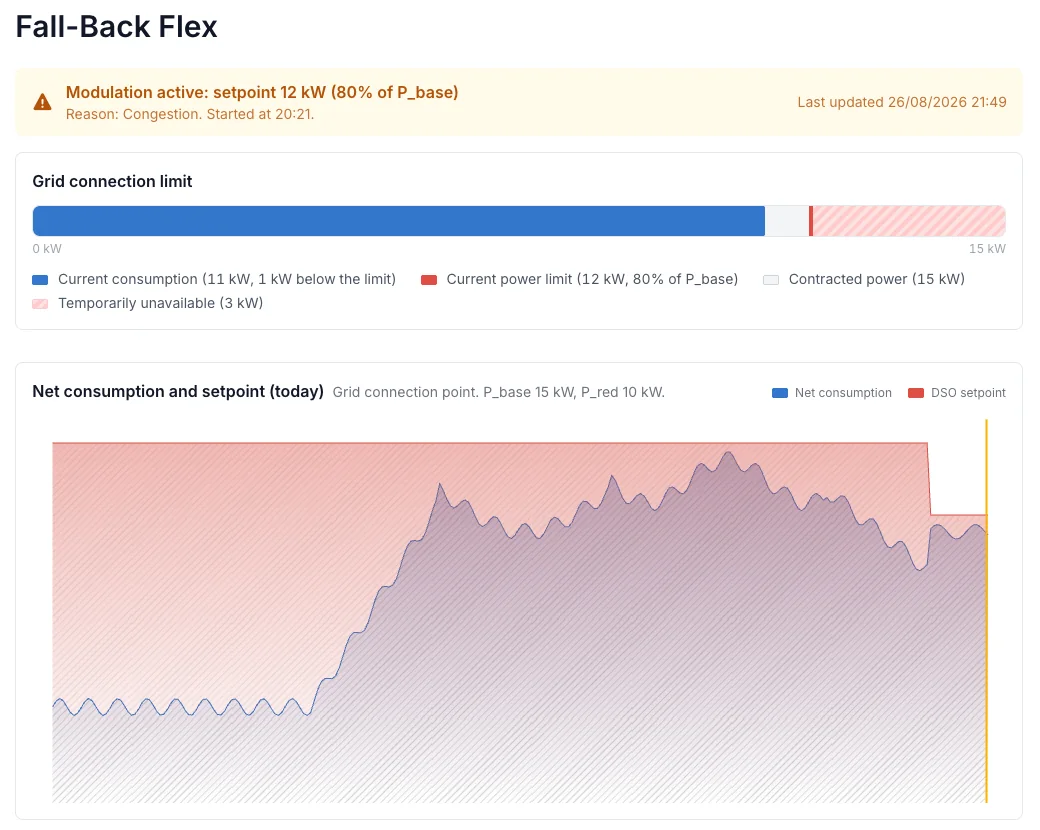
A dedicated Fall-Back Flex dashboard
Real-time status of the grid connection: the active setpoint, the actual offtake and the response time. A chart shows how the installation ramps down within 3 minutes during a control action, and per asset you see how much power was removed.
A history of every control action
Every activation is logged with duration, deepest setpoint, response time and the number of quarter hours below the setpoint. The EMS dashboard also shows at a glance whether a control action is running and which assets are limited.
Day-ahead control
Mandatory in some zonesBeyond the Netflex cabinet: a day plan over API
Where the zone sheet of the connection imposes it, Fluvius supplies a day plan over a secured API on top of the real-time setpoints from the Netflex cabinet: a limit for offtake and injection for every quarter-hour, known a day in advance. Fluvius activates it from the summer of 2026.
Voltmasters EMS retrieves the plan automatically, confirms it to Fluvius and keeps the installation within the limits. Your customer notices nothing of it.
- Known a day in advance
- Updated every day, final the day before delivery.
- Limits per quarter-hour
- A maximum for offtake and one for injection, as a percentage.
- The stricter limit applies
- When the cabinet and the day plan both apply, the installation follows the stricter limit.
- One certificate per connection
- Renewed yearly, 60 to 300 euro a year. Voltmasters guides the application.
Check it per connection: the flag sits per zone sheet, in the column “Verplichte implementatie van Day Ahead sturing” (Dutch). View the zone sheets
FAQ
Frequently asked questions about Fall-Back Flex
What is Fall-Back Flex?
Fall-Back Flex is a temporary connection formula from Fluvius for businesses in zones with grid congestion. The customer gets the full requested power; only when the local grid is under pressure does Fluvius send a setpoint via telecontrol that the installation must temporarily respect.
When does a connection qualify for Fall-Back Flex?
Fluvius offers Fall-Back Flex for new or upgraded connections of 100 kVA or more in zones where grid congestion is expected. The Fluvius zone sheets show per zone whether the formula applies.
What is the Netflex cabinet?
The Netflex cabinet is the telecontrol cabinet that Fluvius installs in the customer cabin. Through that cabinet Fluvius sends setpoints to the installation over the IEC 60870-5-104 protocol and receives measurements and feedback.
Do I also have to exchange the schedule over an API?
That depends on the connection. Where the zone sheet imposes it, Fluvius supplies a day plan over a secured API on top of the real-time setpoints from the Netflex cabinet: a limit for offtake and injection for every quarter-hour, known a day in advance. When both the Netflex cabinet and the day plan apply, the stricter of the two counts. Voltmasters EMS retrieves the plan automatically, confirms it to Fluvius and keeps the installation within the limits.
How quickly must the installation respond to a setpoint?
Within 3 minutes, and the setpoint must be respected for the full control period. Control actions are possible 24/7. The Voltmaster Controller automatically processes every setpoint as a constraint in the optimisation.
What about loads without a communication protocol?
The Voltmasters IO extension controls protocol-less loads through volt-free contacts: heat pumps, cooling units, ventilation and process loads switch along whenever a setpoint requires it.
How long does Fall-Back Flex remain in place?
Fall-Back Flex is temporary: the formula lapses once the planned grid investment in the zone is carried out. Once the regulatory framework for it is finalised, it is automatically converted into a flexible connection agreement (FAO).
What role does the BRP (balance responsible party) play?
The BRP's approval is a fixed step in the application. The customer carries the financial responsibility for the imbalance a control action creates, and makes arrangements about it with their (supplier) BRP in advance.
Is Voltmasters EMS compliant with the Fall-Back Flex requirements?
Yes. The Voltmaster Controller connects to the Netflex cabinet over IEC 60870-5-104, responds within the required 3 minutes, respects the setpoint for the full control period and also controls protocol-less loads through the IO extension. Voltmasters additionally guides the validation and certification with Fluvius.
How do I follow up on Fall-Back Flex control actions?
The Voltmasters platform has a dedicated Fall-Back Flex dashboard with the real-time status of the grid connection, a chart of offtake versus setpoint and a history of every activation, down to asset level. A widget on the EMS dashboard shows whether a control action is currently running and which assets are limited.
A Fall-Back Flex project on your desk?
Together we review the zone sheet, the installation design and the telecontrol coupling, and we guide the certification with Fluvius from start to finish.
Looking for the technical details and step-by-step configuration? You will find them in our documentation.
Read the documentationReady to make your first project pay off?
Tell us about your next installation. We will show you the platform, help you build the business case and guide you from first quote to certification.