If you operate charging stations, you sell kilowatt hours. But every charging session holds a second source of revenue, and most companies in Belgium simply leave it untouched: e-credits.
In this article you will learn what e-credits are, what they can earn, who is entitled to them and why so few companies actually claim them. We also look at what will change in the coming years and how to prepare for it now.
What are e-credits?
Officially, they are called renewable energy units (in Dutch: Hernieuwbare Energie-Eenheden, HEE). They stem from an obligation on fuel suppliers: every year, they must bring a growing share of renewable energy into road transport. They have two ways to do that:
- Blending biofuels into petrol and diesel.
- Buying e-credits from parties that supply renewable electricity to electric vehicles. In other words: from charge point operators.
This turns every kWh your charge points deliver into a tradable product. The system has been running since 1 January 2024 through the Register for Renewable Energy in Transport of the FPS Economy, the Belgian federal economy ministry. One e-credit represents 1 gigajoule (GJ) of renewable energy.
How many e-credits does a charge point generate?
The calculation takes three steps:
| Step | Factor | Explanation |
|---|---|---|
| 1. Convert to energy | 1 kWh = 0.0036 GJ | E-credits are expressed in gigajoules. |
| 2. Multiplier | × 4 | An electric motor is far more efficient than a combustion engine. |
| 3. Renewable share | × 31.27 % | The renewable share of the Belgian electricity mix (2024 figure). |
Together, that gives about 0.0045 e-credits per charged kWh. A site that charges 100,000 kWh a year generates around 450 e-credits a year.
What does that earn?
The price of an e-credit fluctuates strongly. At the end of 2025 it was around 17 to 18 euros, in the summer of 2026 between 8 and 12 euros, and at the end of October 2026 it dropped to about 5 euros, according to EV Belgium. For the example site, that means:
| Price per e-credit | 450 e-credits per year |
|---|---|
| € 5 (end of October 2026) | € 2,250 |
| € 12 (summer 2026) | € 5,400 |
| € 18 (end of 2025) | € 8,100 |
So the moment you sell makes a big difference. But even at today's low price, it is revenue you collect without any extra hardware.
Who qualifies?
- Public charge points: always.
- Semi-public charge points: always.
- Private charge points of a company: from 50 kW combined capacity at one address.
- Home chargers of employees: no.
Above all, logistics companies electrifying their fleet charge large volumes of kWh and therefore build up an interesting number of e-credits.
Why almost nobody claims e-credits
The system itself is not complicated. The problem is the reporting, which takes a lot of manual work:
- You record every week, per charge point (or per EAN), how many kWh were charged.
- You upload that data every quarter, within two weeks, to the register.
- Ideally, you work with a calibrated meter per charge point.
The FPS Economy then validates the data and allocates the credits. Only then can you sell them, directly or through a broker.
In practice, that means pulling exports from different back offices, merging them in Excel, checking everything and uploading it by hand. Four times a year. It is a hassle, so it easily gets postponed or never done at all. EV Belgium has also long been asking for a direct connection to the register instead of manual uploads.
The key: reliable metering data per charge point
To claim e-credits, you need one thing above all: correct and verifiable data on how much energy each charge point delivered.
That data already sits in a good energy management system. For charging infrastructure, the Voltmasters EMS reads consumption per charge point and per EAN, with a one-second control cycle, and stores everything in the cloud with a full history and audit log. Every value can be traced back to the meter and the timestamp. That is exactly what you need when questions come up about your reporting afterwards.
What we are working on
We are looking at how to automate the reporting to the register as much as possible. That way, e-credits become an extra source of value for our partners and their customers instead of a quarterly chore.
What is still to come?
The European directive RED III should have been transposed by 21 May 2025. Belgium has not yet done so for transport. According to EV Belgium, that is an important reason why the price of e-credits has fallen so far, and more than 27 million euros of investment in charging infrastructure risks moving abroad by the end of 2027. The sector is therefore asking for a new framework from 1 January 2027.
If that framework arrives, the targets for fuel suppliers will become stricter and demand for e-credits will rise. Those who already have their data and reporting in order will reap the benefits right away.
Frequently asked questions
How many e-credits does one kWh earn?
About 0.0045 e-credits, based on a renewable share of 31.27 % in the Belgian electricity mix of 2024.
Do my employees' home chargers qualify?
No. Only public and semi-public charge points qualify, as well as private company charge points from 50 kW combined capacity at one address.
How often do I need to report?
You record the charged kWh per charge point every week and upload that data every quarter, within two weeks, to the register of the FPS Economy.
Who do I sell my e-credits to?
To fuel suppliers, directly or through a broker.
In conclusion: charging stations as a source of value
Charging stations are no longer a cost item to run as cheaply as possible. With smart charge planning, EV load balancing, peak shaving, charging at negative prices and now e-credits, you get several sources of value from the same installation.
Are you an installer or operator of charging infrastructure and want to know what we can do for your sites? Email sales@voltmasters.be.
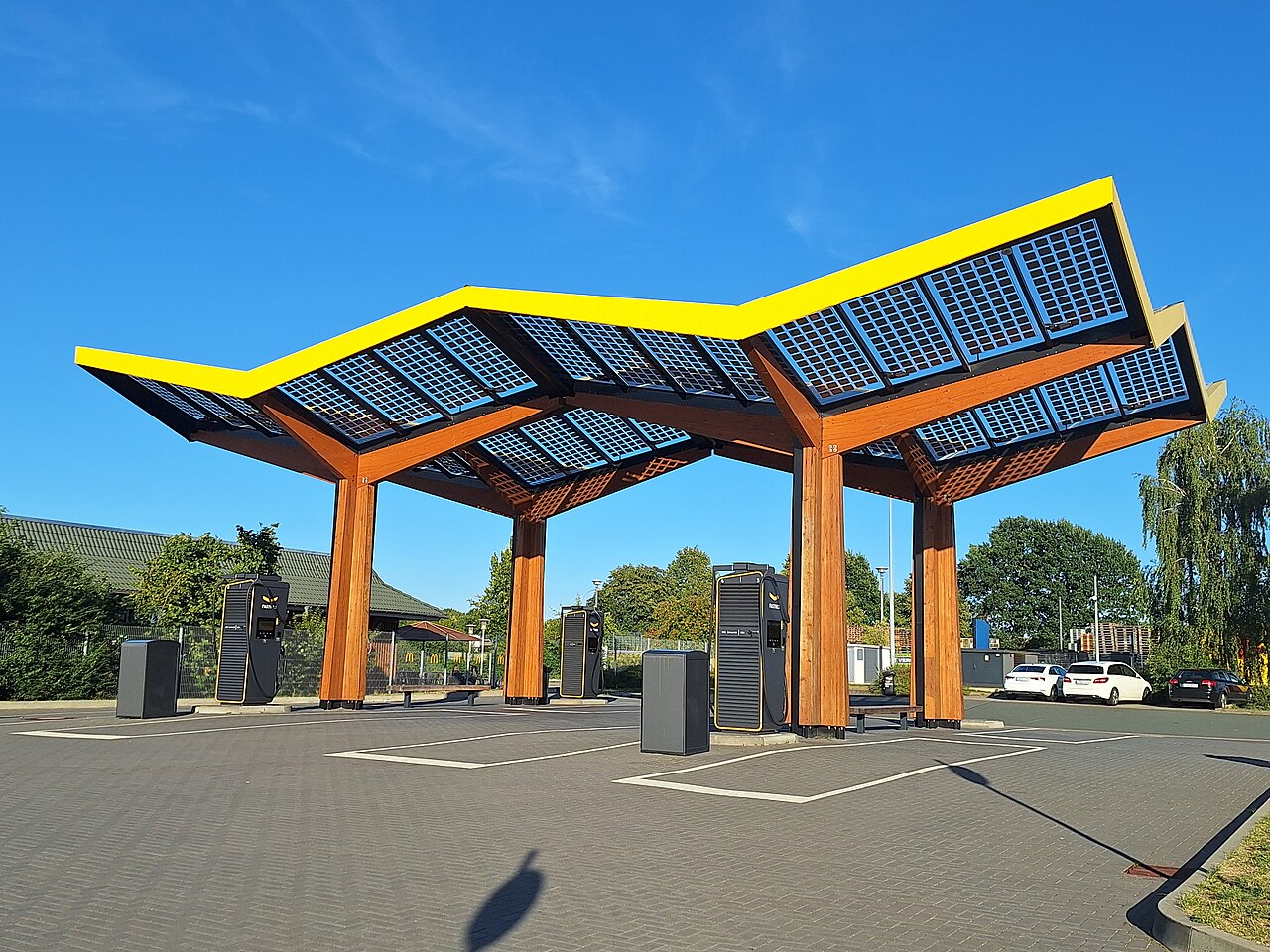
Photo: Steffen Mokosch via Wikimedia Commons, CC BY-SA 4.0.